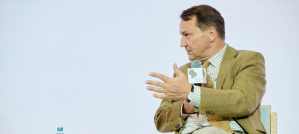

“Peace Through Strength NOW!”. Summary of the 2nd Day of the YES Annual Meeting 2026
The 22nd Annual Meeting of the Yalta European Strategy (YES) “Peace Through Strength NOW!” was held on 11-12 September in Kyiv. 700 leading politicians, diplomats, businessmen, servicemen of the armed forces of Ukraine, veterans, civil activists, and experts from 28 countries took part in the conference organised by the Victor Pinchuk Foundation.
Can Ukraine Keep Functioning in War Conditions?
Prime Minister of Ukraine Sergii Koretskyi stressed that despite the difficult period ahead, Ukraine has enough strength and determination to get through the winter, relying on the support of its partners while addressing tactical priorities and continuing the country’s strategic development.
“We have enough optimism, enough strength, and enough determination to overcome these difficulties. It is a difficult period, that is undeniable. I am counting on the support and joint work to get through the winter with dignity. For the Russians, in my personal opinion, it is a kind of blitzkrieg. We must continue to address our tactical priorities while strategically developing the country,” he emphasized.
Sergii Koretskyi outlined government plans, including the decentralisation of energy and logistics, stronger cooperation with businesses and neighboring countries, and the introduction of flexible border-crossing arrangements to ensure uninterrupted transportation.
“There must be decentralisation — in energy, in logistics and in other sectors as well. We have a clear plan with retailers and logistics companies. We know how to implement it. We have a plan for putting in place logistics measures with our neighboring countries. We are discussing a flexible, fast and uninterrupted border-crossing system — essentially a kind of fast track — so that shipments can be delivered without delay,” he added.
The Prime Minister of Ukraine also spoke about the idea of introducing separate government funding to insure businesses against risks.
“Next is business insurance — war risk insurance. We believe that the traditional model does not work. Together with the Minister of Economy and the Minister of Finance, we have a clear plan to create a separate budget line to which the state would allocate a certain amount of funding,” he stressed.
Is Ukraine Ready for Winter?
Opening the panel, Carl Bildt, Minister for Foreign Affairs of Sweden (2006-2014); Prime Minister of Sweden (1991-1994); Co-Chair of ECFR; Member of the YES Board, said, “The immediate task, apart from those on the front line, the military situation, is to be able to sustain through the winter, when we know that the Russians are intending to make it as difficult as possible. Is Ukraine ready?”
Responding to Carl Bildt’s question, Oleksandr Kravchenko, Minister of Economy and Environment of Ukraine, “Needless to say the situation will be very challenging, and we have to take into consideration the infrastructure that is being destroyed by Russia every day. We estimate destruction of infrastructure and fixed assets will be about 10bn every year, destruction of ports will cause 1.5bn of damage just this year.”
“40bn is at risk from export issues. We are grateful to our partners for export help, but the solution is to find a way to unblock sea freight – we rely on both military and international support to do this.
“It is critical to find support for agriculture – how do we store products whilst we cannot export. What can we do to support agribusiness in advance of next season? What can we do to provide liquidity until we can resume exports at scale?”
Mayor of Kharkiv Igor Terekhov believes that decentralisation is a key tool for effectively mitigating strikes on critical infrastructure and ensuring resilience at the local level.
“Yes, things are difficult today, and yes, we are facing enormous challenges, but we must understand that every city and every community must have a clear action plan. As for Kharkiv, yes, we have chosen the path of decentralization, and we fully understand that the targets our enemy has set are known to us — large combined heat and power plants, water supply facilities, and our energy infrastructure. But decentralization gives us a unique opportunity today to more or less mitigate this major risk,” he said at the YES 2026 Annual Meeting, Peace Through Strength NOW!, in Kyiv.
Igor Terekhov said: “There are many challenges that will confront us. But I am confident that if we have a strong state-minded approach and build teams of professionals at the local level, we will endure. Yes, of course, we need modern air defense; today we also need the support of our international partners. But the most important thing is that we create effective teams — teams of professionals who will work effectively.”
The Mayor of Kharkiv believes that unwavering unity with international partners, timely assistance, and joint daily efforts are the key to Ukraine’s resilience and to achieving a just peace.
“Today, it is very important — extremely important — that both we and our international partners remain united, that we receive assistance in a timely manner, and that we work to ensure that Ukraine stands firm and continues working toward achieving peace,” Igor Terekhov concluded.
Roksolana Pidlasa, Chair of the Verkhovna Rada Committee on Budget, said, “It does not look good for the winter, I will be honest about that. The budget is not great. We have preliminary reports for eight months of budget, national security and defence cost almost 42bn USD – we have raised only 39bn in own revenues and borrowing. Unfortunately, the war has become so expensive that this year we cannot even cover the basic military costs – last year we covered salaries and basic costs for military – we cannot do this any more.”
“Meanwhile, we have heard that budget revenues are severely underperforming. VAT and revenues have started underperforming. The main reason is that Russia deliberately targets revenue producing industries, grain corridors, metallurgical plants, etc. and these things take a lot of time to rebuild, for example it takes three years to rebuild a metallurgical furnace.”
Later in the discussion, she said, “There is one silver bullet, if you provide enough air defences to Ukraine we will not need to refinance logistics centres because we will be able to protect them.”
Anders Asland, Senior Advisor to the KSE Board of Directors, Kyiv School of Economics, commenting from the floor, said, “Thank you Roksolana. You are right - the economy is a disaster. The Port of Odessa is totally bombed and cannot function.
“What can be done? We have to bomb as many Russian ships as possible so they cannot function in the Black Sea and they have to start talking. Same with electricity – bomb more oil refineries (50% of production) so they cannot function.
“And of course – pass the anti-corruption legislation now so Ukraine can unlock the funding.”
Is There a Window for Negotiations Now?
Fareed Zakaria introduced the panel “Is There a Window for Negotiations Now?” by posing a number of questions to the European speakers. “At this point, looking at it from the outside. It feels to me like (Europe) picked a side. You want your side to win. Isn't it best to just do what it would take to let your side win? Because the alternative is that if it loses, that's bad for you.”
Jonathan Powell, National Security Advisor to the Prime Minister of the United Kingdom, shared his expertise based on the experience of many successful negotiations - from Northern Ireland to Hong Kong. “There is a concept called BATNA, which is ‘best alternatives to negotiated agreements’. What we're essentially trying to do is make Putin's alternatives to negotiated agreement worse, and the attraction of an agreement better. And the opposite for Ukraine.”
“War tends to feel endless when you're trapped in it. You think it's never going to end, and then it does.”
“The good news is there's light at the end of the tunnel, and the bad news is that there's no tunnel. What we're essentially trying to do here is build a tunnel. Unless there is a process, unless there's a tunnel, we will not be getting to peace.”
Fabrizio Saggio, Diplomatic Advisor and National Security Advisor to the Prime Minister of Italy, focused on the theme of European institutional unity. “This panel shows how Europe is united, and I believe that Europe must continue to be united. Europe should be more aware of its role in this peace process.
“You were asking about the addition of Ukraine to NATO. But I think it's even more important that Ukraine is part of the EU, and as my German colleagues already said, there was a proposal from the Chancellor in September to start to think of a different way to do this.”
“We need to basically create something robust enough to guarantee that Russia will not attack Ukraine again,” said Emmanuel Bonne, Diplomatic Advisor to the President, National and Security Advisor, Office of the President of the French Republic, “and that Europe and Russia have enough visibility on both sides to coexist and normalise our relationship. It's incredibly ambitious and challenging.
“This war has changed Ukraine, certainly, and changed Europe as well. It’s difficult to say, but maybe for the better – in the sense that we have a much more accurate sense of what we need to do together and the necessities that we share. We have to change the order of priorities that we normally have in the Union.”
Günter Sautter, Political and Security Advisor to the Chancellor of the Federal Republic of Germany, joined a spirited debate about the contributions of Ukraine’s European partners. “Restraints have been lifted… Our course is clear and totally unequivocal. We are standing with Ukraine here, and we are standing together with our European partners in this endeavour.
“We find it crucial that Russia, Moscow, understands this support is not half-hearted, and it will not go away, and it will continue for as long as is necessary.
“Historically, this is not the first time we find ourselves confronted with expansionist, imperial behaviour from Russia. If you look back in history, those who tried to withstand it with good teamwork did much better than those who, for whichever reasons, were not able to do that.”
Head of the Office of the President of Ukraine Kyrylo Budanov believes that the impact of Ukraine’s long-range sanctions became clearly evident as early as the spring and should not be underestimated, as the Russian Federation is already feeling the consequences of these actions.
“First, there has been a sharp deterioration in the position of VTB Bank, which is, so to speak, one of the leading banks in the Russian Federation. Second, there has been a decline — a sharp decline, I would even say a collapse — in the value of Gazprom, which just 20 years ago was valued at around $270 billion. Today, according to various estimates, that figure has fallen to $30 billion. So the impact is significant. At the same time, the Russian Federation still retains the capacity to continue military operations. This is what we all must understand,” he said.
The Head of the Office of the President of Ukraine is convinced that military operations and strikes against Russian targets should strengthen Ukraine’s position while creating additional pressure on Russia and pushing it toward serious negotiations.
“Everything depends on the situation on the battlefield. And everything on top of that — I mean long-range strikes and other similar actions — is aimed at pushing the Russian Federation toward serious negotiations. It strengthens our position and weakens theirs. Eventually, it will have results,” General Budanov noted.
Kyrylo Budanov called on partners to intensify sanctions pressure on Russia and stressed that unity among Ukraine, Europe and the United States is the key prerequisite for countering aggression.
“I urge everyone not to ease the sanctions regime, so that the Russians cannot continue financing the Russian war machine. This is precisely what they have been doing and will continue to do. So let us believe in America, believe in Europe and, most importantly, believe in Ukraine. Together we are strong. If we are united, no one can do anything against us. But if we start pulling in different directions, like the swan, the crawfish and the pike, the outcome will be clear in advance,” the Head of the Office of the President of Ukraine said.
He also noted that Ukraine is ready to play an active role in shaping a new European security architecture and called for deeper cooperation, joint operations and unity with European partners.
“Ukraine is certainly ready to participate — to participate actively — in this [creation of a new European architecture]. Ukraine is proposing this openly, not behind closed doors, but completely openly, starting with the ‘Drone Deals’ that everyone is already familiar with. This is what we can do now, you have to understand that, and extending to proposals for deeper integration of our efforts, cooperation, operations and, ultimately, the unity I have already spoken about and will say again, and which the President of Ukraine speaks about constantly: ‘We are part of Europe.’ Whether someone likes it or not, that is the reality. And we must stand together,” Head of the Office of the President of Ukraine Kyrylo Budanov concluded.
What’s the Kremlin Hoping For — and How to Stop it
In the panel ‘What’s the Kremlin Hoping For - and How to Stop it’, Niall Ferguson, Senior Fellow, Hoover Institution, Stanford University, asked whether Western publics will sustain long-term support: “If you tell people that Ukraine ceases to be entirely in the West and ends up in Russia’s orbit, most people in Britain, France and the U.S. will say: ‘So what? Why should we spend a trillion dollars trying to prevent that?’ That’s the problem here which I think we need to grapple with.”
“We’ve got to look beyond the threat to Ukraine and see that Russia poses a threat far beyond Ukraine,” concluded Ferguson.
Boris Johnson, Prime Minister of the UK (2019-2022), commented that: “The great advantage Putin has, and always has had, is clarity of purpose. He knows what he wants out of this thing. He wants to stop Ukraine ending up in the Western camp, one way or the other, and we’re failing to be clear ourselves. Only clarity will fix this thing.”
“(Putin) is a creep, added Johnson. “He’s a thug. He’s a KGB man and he’s a bully. This is fundamentally an imperial war. It’s about Russia’s sense that there’s no possibility of a Russian future, or a Russian empire, or Russian dignity without Ukraine, and that is an absolute disaster.”
Alice Rufo, Minister Delegate to the Minister of the Armed Forces, France: “Putin totally underestimated the strength of Ukraine, but he also underestimated Europeans. He thought that we would not support Ukraine, that it would not last, that we would not be there, and that we would be divided within NATO and within the EU. The best answer was not to be divided.”
“We need to be clear on the fact that we are going to defend Ukraine and we are going to defend Europe, and not take into account all the time this threat of escalation, which is not true,” Rufo concluded.
David Petraeus, Partner, KKR: “ His (Putin) theory of victory is fundamentally that time favours him. He thinks that he can out-suffer the Ukrainians and the West. He is hoping for the exhaustion of Ukraine and the West, and he wants to see political change in Europe and the United States so that elements start to question whether to continue to support Ukraine.”
“I am very confident that Ukraine can withstand this winter,” added Petraeus “The question is: how painful will it be? The entire society of Ukraine is stepping up to meet this, but the question is whether there are knock-on effects that start to undermine the national resilience that has been on display so impressively until now.”
Taras Kachka, Ukraine’s Representative to the European Union: “The Russian Empire was only successful when Ukraine was part of it. They thought that we were with them, but when we are against them, they lose. Now the question is either we win or we lose. The strategy is clear.”
“Russia will continue to be a danger for us for at least ten years after the war, whenever it ends. The issue of security guarantees for Ukraine for the next decade is more than a €1 trillion issue. We need a decade-long strategy for supporting the Ukrainian army by Europe and other allies.”
Carlo Masala, Chair for Security and Defence Studies, Bundeswehr University Munich commented from the audience: “I’m fully convinced that Russia’s ambition goes far beyond Ukraine. They want to destroy NATO. They want basically to show that NATO is a paper tiger, not willing and able to react if the Russians provoke us at the eastern flank.”
Gabrielius Landsbergis, Former Minister of Foreign Affairs of Lithuania; Founder, NGO Friends of Democracy: “One of the points that has been missed is that it’s not just about Ukraine. It’s about what you would call a greater rebalancing of the European continent. Russia believes that Americans are no longer interested in defending the European continent and that Europeans are just not ready.”
When asked about the scale of the response Europe could make, Landsbergis said: “Ukrainians have been growing drone numbers from a million, to five million, now ten million this year. If we want to send a strong message to Putin: it needs to be 100 million drones per year. With Europe, that is possible, and I think that could send a very serious message to Putin that the rebalancing is not going to happen.”
Can We Cement an Innovation Edge Over Russia and its Partners?
“Innovation comes from three sources:, said Danyil Vakhovskyi, Executive Director, General Cherry. “Changes in tactics from our enemy; changes of tactics from our military people; and technological innovations.”
“Our main focus now is to work much closer with brigades, and we will deliver several products that are designed specifically for certain military units. They will be very effective.”
Sean Plankey, CEO, UFORCE USA, paid tribute to the spirit of innovation that has defined the Ukrainian war effort. “All innovation is standing on the shoulders of giants. Every time, you're building off some major building block that somebody did before. When we look at Western civilization and innovation, we are all standing on the shoulders of giants, and those giants are the engineers here in Ukraine.”
“So much of the innovation that were talked about by my fellow panellists dies on the whiteboard. Breakthroughs never make it off the whiteboard, and they never make it to actually be tested to even to even to the applied stage. They never leave the basic stage of innovation because the financial cycle in the United States, for government investment, is three years.”
“The world and Western civilization is finally waking up to how much maritime is a part of everyone's economy. 90% of everything that everyone owns and is wearing today comes by water. That's the primary mode of transportation: maritime assets.”
Iryna Terekh, CEO, Fire Point, commented that “the technological race is always a spectrum. There are times when you're winning, there are times when you're losing, and this is a completely normal evolutionary process. Sometimes it gets better, sometimes it gets tougher. But this is the way how innovation works in general.”
“In the year 2026, Ukraine launched over Russia twice as more deep strike draws as Russia launched over Ukraine, and this is a number that nobody could ever believe in the year 2022.”
“The question is how we iterate fast,” asked panellist Danylo Tsovk, CEO of Defense AI Center «A1». “How can we move from idea to real device that we can actually validate on the battlefield? We truly believe that AI is an answer, and AI is a strong partner in developing something valuable, something innovative.”
“We truly believe that this technology can be something that provides Ukraine an advantage to create something new, faster, cheaper, and actually to be the first on the battlefield.”
“You can't create, in the defence sphere, an AI solution without real data. A laboratory environment doesn't work. So the capital of the world, unfortunately, now is Ukraine – where technology is used in the field. I truly believe that the next-gen system for supporting the Western world will appear in Ukraine.”
The Future of War and Global Power: Can the West Innovate Fast Enough?
Fareed Zakaria, Host and Bestselling Author, CNN, moderated the panel “The Future of War and Global Power: Can the West Innovate Fast Enough?” and started the session by asking about Ukraine as the frontier of technological warfare: “Ukraine was the frontier of freedom, a brave democracy struggling against the aggression of an authoritarian empire. But Ukraine was also the frontier of technology. Something was happening on the battlefield that was extraordinary.”
“The Ukrainians are being quite innovative. What they need is scale. They need to be able to multiply these systems and mass-produce them. What would it take for Ukraine to achieve the kind of scaling it needs to be able to win this war, when it is up against an adversary four times the population and ten times the economic heft?”
When asked what the West must learn from Ukraine, Dan Driscoll, Former United States Secretary of the Army answered: “We in the West have got to internalise these lessons. What you are doing here in a very scrappy, fast, iterative nature is what we must contort our systems to achieve at scale. We’re currently doing it, oftentimes, with the wrong products.”
“Within this inflection point, we are at a moment where everything is about to change again. The speed and scale of the AI and compute that is about to hit these weapon systems will be an amazing opportunity for Ukraine to outrun the Russians, out-innovate them and out-partner them. We are a couple of months away from new solutions changing the very nature of how warfare will occur.”
Eric Schmidt, Former CEO and Chairman, Google discussed how warfare was changing: “Pretty much all of the traditional assumptions about war and particular devices are probably false now. Ships are big targets. Tanks are a terrible idea. These drones appear to be toys, but especially when swarmed, they are extraordinarily powerful.
“Ukraine, after four and a half years of war, knows what it is doing. The country is organized to win this. What’s missing? Money, and the second is scaling. This is a big war. You need a lot of everything. The correct solution is to use contract manufacturers in the West to assist in getting the necessary defensive and offensive systems to Ukraine.”
Radosław Sikorski, Deputy Prime Minister & Minister of Foreign Affairs of the Republic of Poland, was asked a question from the audience regarding US funding, European support and frozen Russian assets. “The obvious answer,” he responded, “is that half the funding has petered out because the United States did not follow up with another supplemental package. The U.S. is not funding the war. It is selling some weapons to Europe, but it is not funding Ukraine. What would be really helpful is for the U.S. to match the European effort. The European Union has extended a €90 billion loan, which is not fully disbursed yet, and there is an obvious pot of money in frozen Russian assets. We have already said Russia is not getting this money until it has paid reparations to Ukraine. The only question is: do we pass the money to Ukraine after the war to rebuild it, or now to prevent it from being destroyed?”
Can Europe with Ukraine Deter Russia?
Opening the panel, moderator, Nataliya Gumenyuk, CEO, Public Interest Journalism Lab, said, “I will take the liberty of renaming the panel. There is no doubt, Europe with Ukraine CAN deter Russia. But one cannot do it without the other.”
Ihor Zhovkva, Deputy Head of the Office of the President of Ukraine, responded, “Yes – no doubt. In every process, there are some buts, ifs, and unfortunately, some delays. We not only can, but should and will deter Russia. For that, there are three very important conditions:
- Courage and political will. Compare 2022 to now, at least the countries in this audience have the political will – vis-à-vis Ukraine – unlike the situation in 2014 when Europe overslept on Crimea. Had European nations had this same political will in 2014, or in 2021, the aggressor would have thought twice about this awful and stupid decision. And that would not have been so disastrous for us Ukrainians.
- Finance – war investment. The drone industry in Ukraine is underinvested. It is much more cost-effective to invest now, than to rebuild from scratch something in your home countries.
- Speed, velocity, readiness to react, quick answers. Ukraine is living at high speed, what we are asking from your countries is, if you cannot go at our speed, then at least go at half this speed.”
Radoslaw Sikorski, Deputy Prime Minister and Minister of Foreign Affairs of the Republic of Poland, said, “What we need to deter Putin is to convince him, as the Europeans, we would fight. We have the means to impose prohibitive costs on him. Just the Council of Baltic Sea States has a bigger peacetime defense budget than Russia has a wartime defence budget.”
Moritz Schularick, President, Kiel Institute for the World Economy, spoke to the audience about the economic paradox of European defence, stating, “European GDP is larger than China at 26-27 tn dollars. Until about a decade ago, it was the same size as the US, and it is 17x larger than Russia.
“Last year we spent 2% of GDP on defence
We spent 60% of what the US spent. Do we get anything like 60% of the capabilities?
“The question is not one of inputs, it is one of outputs. If the US had 50 armies, 50 navies, 50 Airforce’s, it would be as inefficient as Europe in terms of outputs.
“We have to face up to that. We live in a fragmented inefficient European defence world. Ukraine can help us with that.”
Joachim Kaschke, Chief of Central Management Staff and Head of Special Staff on Ukraine, German Federal Ministry of Defence, said, “We can talk about the will to fight. Personally, yes, for sure, we would fight if we need to. In a strong alliance, one of the most powerful alliances in the world.
Regarding the anti-ballistic coalition, he continued, “Countries must bring industry together via incentives. The capability is necessary – we need interceptors. Despite all efforts to have a scalable solution, we are not there yet and will need more time to produce a scalable solution.
“Because of the pressure, there is a strong sense of responsibility.”
Benjamin Haddad, Minister Delegate for Europe, Ministry for Europe and Foreign Affairs of France, told the audience, “Russia calculated that we would lose resolve, and it hasn’t happened. We’re here 4.5 years later discussing a 22nd package of sanctions for Russia, we are providing 100% of the investment, we saw that meeting in Oval office, we stepped up, we secured the 90bn funding, and we have a more united European Council thanks to the Hungarian election.
“The key is to accelerate what we are doing now, because Russia is becoming more aggressive.
“We need to invest more quickly, and more wisely, currently too much of that money is going to procurement outside Europe.”
Ukraine – Historical Innovation Territory
The panel “Ukraine – Historical Innovation Territory” took a deep dive into Ukrainian history inspired by an ongoing research project. Moderator Niall Ferguson, Senior Fellow, Hoover Institution, Stanford University, reflected that “Ukraine has had this exceptional role in modern history of extreme conflict, and we're touching on part of the reason for that. It's topography, it's accessibility, it's desirability, it's being a place where cultures mix, but also collide. And we're also talking about the forces of evil and good that did battle here.”
Timothy Snyder, Munk School: “You can't really do contemporary politics or contemporary strategy without history,” said Snyder.
“It's a great credit to Ukrainians in general and to my Ukrainian colleagues in particular that during a moment of war, when much else is going on, they are applying themselves with even greater urgency and concentration, but also generosity and curiosity to the big question of who Ukrainians are.”
Borys Gudziak, Metropolitan Archbishop, Archeparchy of Philadelphia, Ukrainian Catholic Church, weighed in: “There's a deep ethical quality to (this project on Ukrainian history). We're in the middle of a war. A war is destruction and separation. It's this war is built on historical lies, and it's also built on the history of empires and religions.”
“Because in people's minds there's a Russo-centric view on Slavic history, people thought Ukraine wouldn't last for three days. It transfers into very clear strategic and tactical mistakes and misconceptions”
Yaroslav Hrytsak, Historian and Doctor of Historical Sciences as well as Professor at Ukrainian Catholic University, made links between the current situation and Ukraine’s past. “It's not just now that Ukraine has had a global dimension. It was several times before – the First World War, Second World War, in the seventeenth century, when domesticating, when building the first cities.
“This is crucial territory. If you want to be a modernised superpower, you have to have control over this territory because of resources, because of the political situation.
“With Ukraine, Russia is (a superpower) like the United States. Without Ukraine, Russia is like Canada… this is the historical mission of Ukraine. To make Russia a normal state, make it a Canada.
“This is the crucial difference between Ukraine and Russia. Luckily enough, Ukraine has no golden age, nowhere to return to. Ukraine’s golden age is in the future!”
From the Frontline to Our Partners: Peace Through Strength NOW
“This is an existential war — a war to preserve ourselves, to preserve our community, to preserve our society itself, but at the same time it is also a war for this state. I think this is what distinguishes us today from who we were a hundred years ago. And I believe that this is precisely why Ukraine will not lose this war,” added Serhii Zhadan, Soldier, 13th Operational Brigade “Khartiia.”
Commander of the 429th Separate Unmanned Systems Brigade “ACHILLES” Yurii Fedorenko noted: “To stop the fighting, we must work at an accelerated pace so that the Ukrainian state and the Ukrainian military receive everything they need to weaken and destroy the Russian Federation. At the same time, we must not forget about sanctions policy. Sanctions are what gradually eat away at the enemy, but it is critically important to strengthen them and ensure enforcement. Then direct firepower, long-range weapons, and sanctions policy together are what deprive Russia of the ability to conduct active combat operations.”
Artillery Reconnaissance Officer of the National Guard of Ukraine Olena Apchel is convinced that impunity is itself a weapon — one that a significant part of the international community has, knowingly or unknowingly, continued to place in Russia’s hands since 2014.
“I believe that impunity is also a weapon. Unfortunately, during the first eight years of Russia’s war against Ukraine, most of the international community placed this weapon in Russian hands. I believe that this is the kind of weapon that, unfortunately, part of the world continues to hand to Russia every time it continues to call Russia’s war against Ukraine a conflict, an event, a difficult situation, aggression…,” Olena Apchel stressed.
Head of Air Defense of the 7th Rapid Response Corps of the Air Assault Forces of the Armed Forces of Ukraine Artem Skurativskyi is convinced that the evolution of Ukraine’s capabilities, provided it receives the necessary tools, means that Ukraine can move from calling for imposing a no-fly zone over Ukraine in 2022 to being ready to ensure the safety and security of airspace far beyond Ukraine on its own.
““In 2022, we asked for the skies over Ukraine to be closed. Now I can say with confidence: give us the tools, and we will not only close the skies over Ukraine, but also protect the entire world.”
Closing
Aleksander Kwaśniewski, President of Poland (1995–2005) and Chairman of the YES Board, closed the conference stating: “Ukraine’s real strength is its people, its army and its young generation. It is a well-educated, extremely determined and patriotic generation, with an unbelievable capacity to develop and introduce new technologies. Europe’s unity is also a great strength, and today the majority of support is coming from Europe.”
“The worst thing that could happen today, with Putin and his imperialist policy on one side, would be a division between America and Europe. We need to work together, not simply through step-by-step decisions and reactions, but with a strategy for Ukraine. The place of a democratic, sovereign Ukraine is in the North Atlantic Alliance,” Kwaśniewski added.
Photos from the YES Annual Meeting 2026 are available here
Videos are available at our YouTube channel
←Back to news list