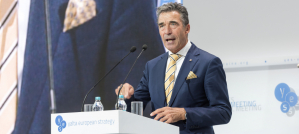

In July 2004 Victor Pinchuk gatheres about 30 European Leaders for the first Yalta European Seminar to debate about Ukraine’s prospects of joining the EU. The participants of event include Prime Minister of Canada (1993–2003) Jean Chretien, French MP Dominique Strauss-Kahn, member of European ParliamentMarek Siwiec. On the second day of that first successful meeting several participants propose transforming the private initiative into an international collective organization to promote Ukraine joining the EU. Hence, the Yalta European Seminar is transformed into the Yalta European Strategy. An independent philanthropic foundation is established in Ukraine.
YES publishes the first European Survey showing that Ukraine is #1 favorite candidate for the EU accession: 55 % of Europeans want Ukraine to join the EU, 31 % is against that. The survey, done by TNS Sofres, reflects opinions of citizens of major EU states (France, Germany, Italy, Poland, Spain, United Kingdom) about Ukraine’s EU membership. For the first time, the survey brings the ground-breaking news: Ukraine’s accession is welcome by Europeans. That changes views of what EU citizens think about Ukraine.
YES organizes the 2nd Yalta Annual Meeting a high-level event that brings together about 70 political, business and society leaders to talk about “ U in the EU: next steps for Ukraine?”. The participants include Prime Minister of France (1998–1991) Michel Rocard, MP; State Secretary of the Ministry of Foreign Affairs of Slovakia Magda Vasaryova; State Secretary for European integration of Croatia Marija Pejcinovic Buric; and President of International Crisis Group Gareth Evans.
YES Board Members meet President of the European Commission Jose Manuel Barosso to call for the EU’s more proactive stance on Ukraine on the eve of EU-Ukraine Summit starting on December 1 2005.
YES presents the findings of the second wave of its European public opinion survey – the day before the EU-Ukraine summit in Kyiv – to the Ukrainian politicians, society and the media. The survey confirms Europeans’ support for Ukraine’s future within the EU. Ukraine is ranking as the number one favorite candidate to accession, not only generally (51%), but also in each of the six countries covered by the survey (France, Germany, Italy, Poland, Spain and United Kingdom), which together account 75% of the total population of the EU. The result suggests that the idea Ukraine’s inevitable accession is being already set in European minds.
YES international conference in Berlin gathers about 400 participants to discuss Ukraine’s political development after the parliamentary elections and perspectives of the key political forces on European integration. Representatives of Nasha Ukraina and Yulia Tymoshenko Block present their parties’ views on the future coalition and the steps that Ukraine should make to get closer to the EU.
YES Board meets with EU Commissioner Benita Ferrero Waldner to urge that the EU should go beyond the European Neighbourhood Policy in relations with Ukraine. The Commissioner stresses the importance of a more productive political dialogue with Eastern Ukrainian elites. YES Board invites the Commissioner to address the regional elites and society at YES regional conference during her visit to Ukraine.
The 3rd Yalta Annual Meeting gathers over 120 high-level politicians, thinkers, business leaders and journalists from Ukraine, the EU and the rest of the world. Speakers at the conference include Prime-minister of Ukraine Yuri Yekhanurov, Speaker of the Parliament of Ukraine Olexander Moroz, President Kwasniewski, Prime Minister of Croatia Ivo Sanader, Minister of Foreign Affairs of Romania Mihai Ungureanu, chairman of the NATO Parliamentary Assembly Peirre Lelouche, chairman of the Foreign Affairs Committee of the European Parliament Elmar Brok and the President of the Brookings Institution Strobe Talbott. In his video address to the 3rd Yalta Annual Meeting, President of the European Commission Jose Manuel Barroso speaks highly on the YES contribution to developing relations between EU and Ukraine.
YES presents Agenda 2020, a strategy of Ukraine’s accession to the EU. President of Poland (1995–2005) Alexander Kwasniewski joins the Board of YES.
YES Board meets President of Ukraine Victor Yushchenko to present the Agenda 2020. “No doubt, the report provided by the representatives of the Yalta European Strategy, and the fixed date of 2020 should be very carefully studied by our politicians, our statesmen, and it should be taken into account when shaping our stategy and tactics of implementation of the European integration course.” Deputy Head of the Presidential Secretariat Olexander Chalyi formulates President Yushchenko comments for a press briefing following the meeting. Agenda 2020 is also presented to the Brussels policy-making community.
YES international conference in Berlin with Prime Minister of Ukraine Viktor Yanukovych as key speakers gathers about 400 participants. The Prime Minister’s speech signals the government’s intention to establish a more effective and constructive relationship with leading EU countries and Brussels. The YES Board meets with Mr. Yanukovych to discuss Ukraine’s further steps in developing Ukraine’s relations with the EU.
YES Board Member speaks in public debate in Lviv, Dnipropetrovsk and Donetsk to bring the discussion of Ukraine’s European Debate Forum , organized in partnership with International Rennaissance Foundation and the leading regional universities and think-tanks, gathered about 1 300 students, academia, local government officials, civil society activists, and journalists to discuss Ukraine’s European identity and its relations with the EU.
YES co-organized Europe Day at the largest avenue of Kyiv with the Delegation of the European Commission and takes debates with politicians and diplomats to Ukrainians in the streets. The Public discussion hosted by YES in Kyiv attract over 500 participants. Speakers include Deputy Head of the Secretariat of the President of Ukraine Olexander Chaliy, Deputy minister of Foreign Affairs and the head of Ukrainian delegation negotiating the new agreement Andriy Veselovsky, Head of the Delegation of the European Commission to Ukraine Ian Boag and Ambassadors of the EU Member States.
YES gathers about 200 participants, including President of Ukraine Victor Yushchenko, President (1994–2001) of the USA William J. Clinton, Chancellor of Germany (1998-2005) Gerhard Schroeder, Prime Minister of Slovenia Janez Jansa, President of Poland (1995–2005) and YES Board member Aleksander Kwasniewski to discuss the Agenda 2020 and the future of the EU-Ukraine relations, the changing political leadership in Europe and the world, prospects for a EU – Ukraine free trade area, energy challenges and the judiciary reform.
Based on discussions with Ukrainian decision-makers and businesses, YES discussed with Commissioner Mandelson the issues faced by Ukraine in the process of the WTO accession and preparing for negotiations of the future Free Trade Agreement between the EU and Ukraine.
The objective is to develop a platform where new strategies for a changing Europe and Ukraine are debated. YES also keeps on promoting and lobbying the necessary reforms, the “homework” to be done, indispensable for Ukraine to join the EU and a goal in the EU integration process.
56% of French citizens support Ukraine’s accession to the EU, said an opinion poll, performed by TNS Sofres for YES on February 5–6. Members of the Board of YES met President Nicolas Sarkozy before his meeting with Ukraine’s President Victor Yushchenko in Paris to present these results.
Immediately after the FTA negotiations between the EU and Ukraine are launched in Kyiv by EU Commissioner Peter Mandelson and President of Ukraine Victor Yushchenko, YES joins forces with the European Business Association to launch debate with the business community and policy-makers on how to make the FTA work.
The FTA Forum is designed to bridge the gap between research, analysis and policy-making. Leading FTA experts from Ukraine and the EU work on recommendations for the FTA negotiations. The expert conclusions are presented to the political/government elite and debates with top decision-makers. The participants of the debate, moderated by President of Poland (1995–2005) and YES Board member Aleksander Kwasniewski, include Vice Prime Minister of Ukraine for European and International Integration Hryhory Nemyria, leaders of parliamentary committees and ministries, and the opposition. The Forum is organized in partnership with the World Bank and the EBA with support of the Delegation of the European Commission to Ukraine and the Victor Pinchuk Foundation.
To bring the debate on the future of Europe and Ukraine to the Ukrainian people, YES takes a lead in organizing public discussions in the main street of Kyiv, Odessa and Donetsk. The debate is part of the Europe Days in Ukraine, in which YES is a special partner of the Delegation of the European Commission to Ukraine and the Ministry of Foreign Affairs of Ukraine. An interactive poll done by YES in the three cities reflects Ukrainians’ perceptions of their country’s prospects.
At its fifth anniversary YES makes its assessment of Ukraine’s progress on the way to the EU towards the goals outlines in Agenda 2020. The 5th Yalta Annual Meeting brings together over 200 prominent personalities of politics, business and society to take a global perspective on the key challenges and opportunities for Europe and Ukraine. The proposed solutions address issues from the global financial and economic crisis, gas supply and the future EU-Ukraine free trade area to building synergy in the Black Sea Region and opportunities for boosting infrastructure investment and making the EuroCup 2012 a success. The participants of the 5th Yalta Annual Meeting include Prime Minister of the UK (1997-2007) Tony Blair, President of Georgia Mikhail Saakashvili, IMF Managing Direcvtor Dominique Strauss-Kahn, Speaker of the Ukrainian Parliament Arseniy Yatseniuk, Secretary of the National Security and Defense Council of Ukraine Raissa Bohatyreva, and Vice Prime Minister of Ukraine for European Integration Hryhory Nemyria.
The 2nd YES University brings together about 150 young and future political and society leaders from Ukraine, the EU member states and the rest of Europe – all in all, 27 countries - to debate the future of the EU and Ukraine – from the global crisis, the Lisbon Treaty, the risk of a new “cold war” and a common foreign and security policy to the transformation Ukraine should undergo - with politicians from the EU and their Ukrainian counterparts. Speakers of the 2nd YES University include European Commissioner for Education, Training, Culture and Youth Jan Figel, Speaker of Parliament of Georgia (2004–2008) Nino Burjanadze, President of Poland (1995–2005), Member of the Board of YES Aleksander Kwaśniewski, Minister of Defence of Ukraine (2005–2007) Anatoliy Hrytsenko, MP, Director of the Institute for New Economy, member of the 1st, 3rd and 4th Russian State Duma Sergey Glaziev, Vice-Prime Minister of Ukraine on European Integration Hryhoriy Nemyrya, Speaker of the Parliament of Ukraine Arseniy Yatseniuk, Minister of Youth, Family and Sports of Ukraine Yuri Pavlenko, and Chairman of the Delegation to the EU-Ukraine Parliamentary Cooperation Committee Adrian Severin.
YES cooperates with the Konrad Adenauer Stiftung and the Viktor Pinchuk Foundation in launching a youth debate forum within which future leaders and experts from Ukraine address the challenges faced by their country. The issues discussed include interdependencies between globalisation, democracy and the Ukrainian modernisation in the sphere of politics, economy and society; approaches for a successful integration of Ukraine into the global economy; links between prosperity and democracy, the capabilities of the nation state, transnational cooperation as well as future strategies for the economic and democratic development of Ukraine. Over 100 participants the conference include fellows of the YES University, ZAVTRA.UA, and the Kyiv School of Economics.
YES is a partner of the Centre on the United States and Europe at the Brookings Institution and the Viktor Pinchuk Foundation in the “Frontiers of Europe” conference that brings together a select group of leading senior officials and experts from the United States, the European Union, NATO, Russia, Ukraine to assess Western policies to solve pending regional issues and to advance the process of stabilization and integration.
"The Euro-integration of Ukraine is not questioned anymore. Now it is time to move forward and to design and implement the necessary reforms. Because, after all, reforming Ukraine is the real goal of this process. And YES will continue to advocate the European destiny of Ukraine and help Ukraine to do its indispensable homework.”
(Victor Pinchuk, Founder and Member of the Board of YES)